


Signs of a Bad Engine Tune and How to Diagnose Them
Last Updated: November 15, 2026
Quick Summary
A bad engine tune is a calibration that doesn't match your engine's actual airflow, fuel, and timing needs, showing up as a hunting idle, knock retard in logs, climbing fuel trims, or a flat spot at part throttle. Catch these early warning signs before the loud ones, like a check engine light after a fresh flash, appear.
- A well-calibrated map should feel boring at part throttle and brutal at full throttle.
- Audible knock at wide-open throttle is a hard stop and can crack a piston ringland.
- Misfire on one cylinder only likely points to a coil, plug, or injector.
- A misfire bad enough to flash the check engine light can melt the catalytic converter substrate.
- If a symptom appeared the same day you flashed, suspect the tune rather than hardware.
Table of Contents
- What a Bad Engine Tune Actually Looks and Sounds Like
- Engine Knock After Tuning: When It's Dangerous
- Engine Misfire After Tune: Causes and Red Flags
- Engine Running Lean Symptoms You Shouldn't Ignore
- How to Diagnose a Bad ECU Tune with Logs and Scan Tools
- Telling Tune Problems Apart from Mechanical Faults
- When to See a Professional Tuner
- Book a Dyno Session to Verify Your Tune
- Frequently Asked Questions
What a Bad Engine Tune Actually Looks and Sounds Like
A bad engine tune is a calibration that doesn't match your engine's actual airflow, fuel, and timing needs, and it usually announces itself long before it destroys anything. At Taylor'd Tuning, we diagnose these problems on Subaru, GTR, Mustang, and GM platforms. The signs follow a pattern, and once you know it, you can catch trouble early.
The early warning signs checklist:
- Idle that hunts or stumbles when cold
- Knock retard showing up in logs under load
- Fuel trims climbing past normal corrections
- A flat spot or surge at part throttle
- Check engine light after a fresh flash
- Power that falls off instead of pulling clean to redline
- Rough cold starts that smooth out once warm
The first four items are quiet, you feel them as "the car just feels off." The last three are loud, and by then you've likely been driving on a problem for a while.
A well-calibrated map should feel boring at part throttle and brutal at full throttle. If your car feels nervous everywhere, the tune is asking the engine to do something it can't safely deliver.
Engine Knock After Tuning: When It's Dangerous
Engine knock after tuning is dangerous the moment it's audible under load, and it's a hard stop if you hear it at wide-open throttle. Knock is the sound of fuel igniting early and slamming the piston. A little false knock from a loose heat shield is harmless. Real knock under boost is not.
Modern ECUs pull timing when they detect knock, so you may never hear it. Logging the engine under load is a more reliable way to catch knock than listening alone.
When to stop driving immediately:
- Audible rattle or pinging under acceleration
- Knock retard that stays high through a pull
- Any knock combined with rising coolant temps
- A sudden loss of power with a metallic sound
Continuing to drive on audible knock at full throttle can crack a piston ringland before your next oil change. On a built Subaru, that's an engine-out repair.
If you see knock counts in your logs but can't hear anything, investigate the tune's timing and fuel tables rather than pushing harder. A proper calibration leaves a safety margin for pump fuel quality and summer heat.
Engine Misfire After Tune: Causes and Red Flags
An engine misfire after a tune usually points to one of three things: spark plugs gapped for stock boost, ignition coils that can't handle the added cylinder pressure, or a tune that's pushing timing the fuel can't support. The misfire itself is a symptom. The cause lives upstream.
A misfire is a cylinder that failed to burn its charge, or burned it late and weakly.
Red flags that separate a tune problem from a hardware problem:
- Misfire on one cylinder only: likely a coil, plug, or injector
- Misfire that moves around: often fuel or timing related
- Misfire under boost only: gap, plug heat range, or tune
- Misfire at idle after a flash: calibration issue
- Misfire that appears only when coolant is hot: often a coil breaking down under heat
- Misfire that clears when you lift off the throttle: usually load-dependent, so suspect gap or calibration
A common mistake is throwing parts at a misfire before checking the tune's timing and fuel targets.
What the scan tool should show you. A generic code reader gives you P0300 for a random misfire or P0301 through P0308 for a specific cylinder, the starting point, not the answer. A scan tool that reads live data and Mode $06 gives you misfire counters per cylinder.
Watch out: a misfire that is bad enough to flash the check engine light is dumping raw fuel into the catalyst, and continuing to drive can melt the substrate. That is a stop-and-diagnose condition, not a drive-it-home-and-look-later condition.
According to documentation on OBD-II misfire diagnostics from the EPA, misfire codes exist specifically because unburned fuel damages catalytic converters. That's your reason to fix it fast, not to ignore a "minor" stumble.
The logging check. Log misfire counts per cylinder, short-term and long-term fuel trims, commanded versus measured air-fuel ratio, and knock retard during a controlled pull. If the misfire count rises as fuel trims swing lean, the tune is leaning out that cylinder and the misfire is a fuel problem.
Engine Running Lean Symptoms You Shouldn't Ignore
Engine running lean symptoms include high fuel trims, lean air-fuel ratios under load, hesitation, and elevated exhaust gas temperatures. Lean means too much air and not enough fuel, and under boost it's the fastest way to melt a piston.
The signs to watch:
- Positive fuel trims climbing toward their limit
- Air-fuel ratio leaning out as RPM rises
- Hesitation or surging on tip-in
- Hot exhaust, sometimes glowing manifolds
- Detonation that shows up as knock
What most guides miss is that a lean reading can come from the tune or from a mechanical cause like a failing fuel pump or a boost leak. That's why you log before you retune.
How to Diagnose a Bad ECU Tune with Logs and Scan Tools
Diagnosing a bad ECU tune starts with data, not guesses. You need to log the engine under real load and compare what the ECU commands against what the engine actually does.
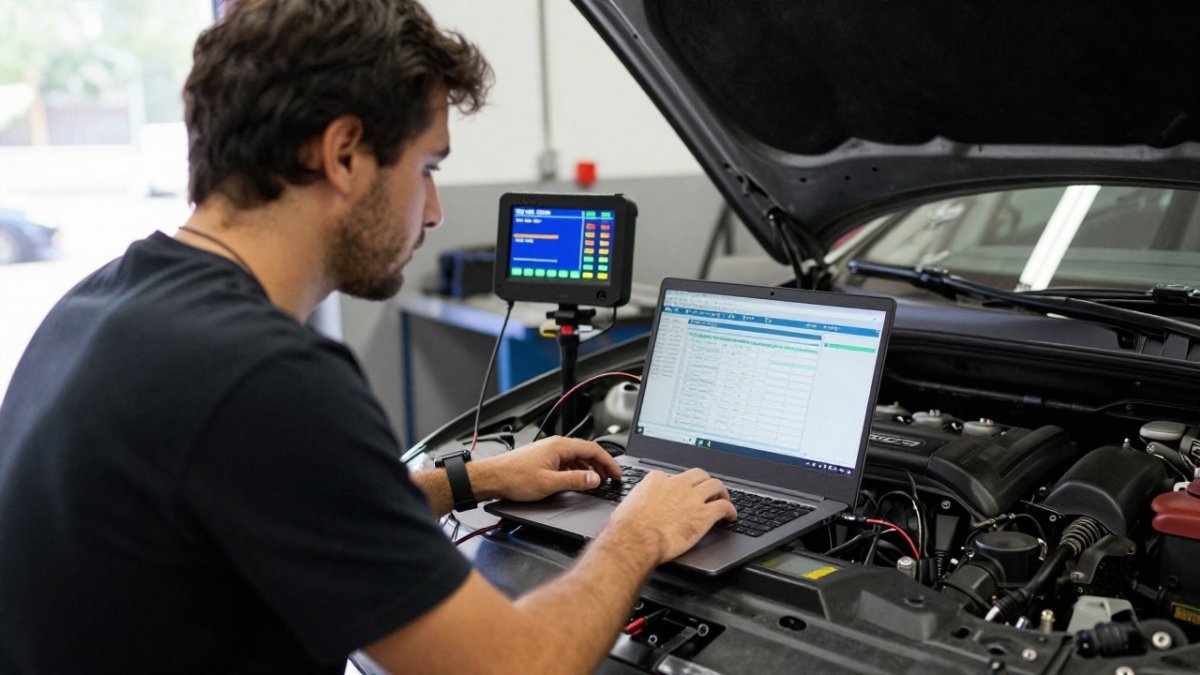
The diagnostic steps we use:
- Pull stored and pending trouble codes with a scan tool
- Log fuel trims, AFR, knock retard, boost, and timing under a controlled pull
- Compare commanded AFR to measured AFR
- Check whether knock appears and when
- Review fuel trims at idle, cruise, and wide-open throttle
- Look for patterns: load-dependent, RPM-dependent, or random
The codes that point at calibration. P0171 and P0172 (system too lean or too rich on bank 1) and their bank 2 equivalents P0174 and P0175 are the fuel-trim codes you will see most often after a bad flash. P0300 through P0308 are the misfire family. P0325 and P0330 are knock sensor circuit codes, and P0420 or P0430 are catalyst efficiency codes that often appear after a misfire has been dumping fuel into the converter.
How to read fuel trims. Fuel trims are the ECU's correction for how far the actual mixture is from target: positive means adding fuel because it sees lean, negative means pulling fuel because it sees rich. Small corrections at cruise are normal; the pattern is what matters.
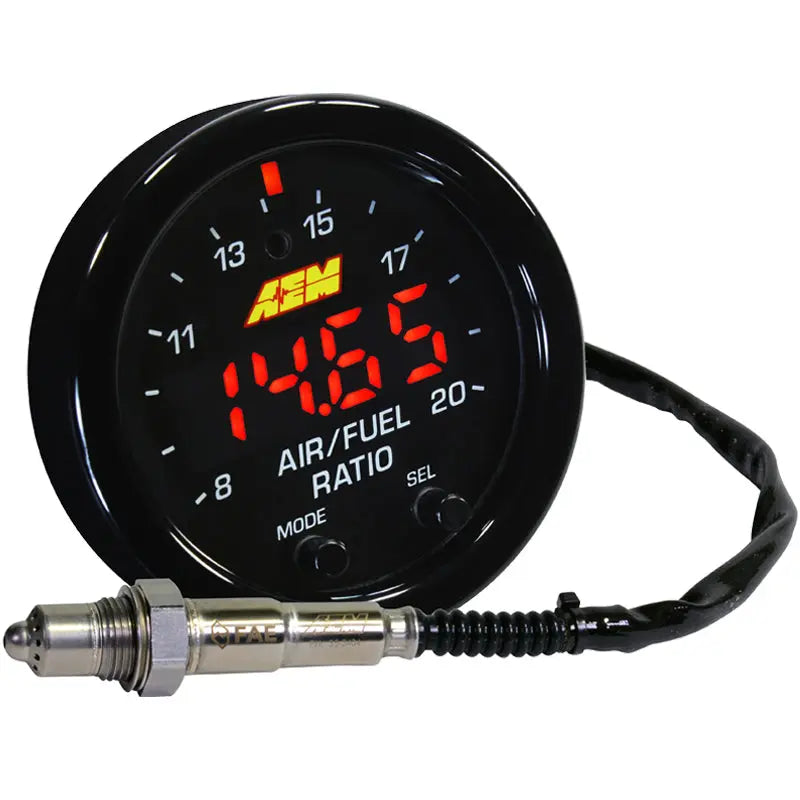
Commanded versus measured AFR. A useful comparison in the log is what the tune asks for and what the wideband reads.
You can't read air-fuel ratio accurately without a wideband. A narrowband sensor only tells you rich or lean, not how far. The AEM X series wideband gauge gives you a real AFR number to log against the tune's target.
Watch out: logging a full-throttle pull on the street is how people and engines get hurt. Use a controlled stretch of road with a passenger watching the laptop, or put the car on a dyno where load and heat are repeatable.
If you want to understand how a base map is built, our guide on building a custom base map walks through the tables a tuner adjusts. Knowing that structure helps you judge whether your fault sits in the calibration or the hardware.
Telling Tune Problems Apart from Mechanical Faults
The fastest way to separate a tune problem from a mechanical fault is to ask one question: did anything change when the map changed? If the symptom appeared the same day you flashed, suspect the tune. If it crept in over weeks, suspect hardware.
A boost leak, a tired fuel pump, a clogged injector, or a failing coil all mimic tune problems. The difference is repeatability. A tune fault shows up in the same conditions every time. A mechanical fault drifts.
Quick separation guide:
| Symptom | Likely Tune | Likely Mechanical |
|---|---|---|
| Knock under load | Timing too aggressive | Bad fuel, hot intake |
| Lean at high RPM | Fuel table short | Weak pump, clogged filter |
| Misfire one cylinder | Rare | Coil, plug, injector |
| Rough idle after flash | Calibration | Vacuum leak |
If you're unsure, log first and retune second. Our performance tuning guide for track days covers how a healthy tune should behave under sustained load, which gives you a baseline to compare against.
When to See a Professional Tuner
See a professional tuner when your logs show knock you can't explain, fuel trims you can't correct, or a symptom that survives a fresh flash. Some problems are calibration. Some are hardware. A tuner with a dyno can often sort out the difference in a single session.
Not everyone wants to hand over the keys. For owners who want to learn, we offer one-on-one tuning instruction and consultation.
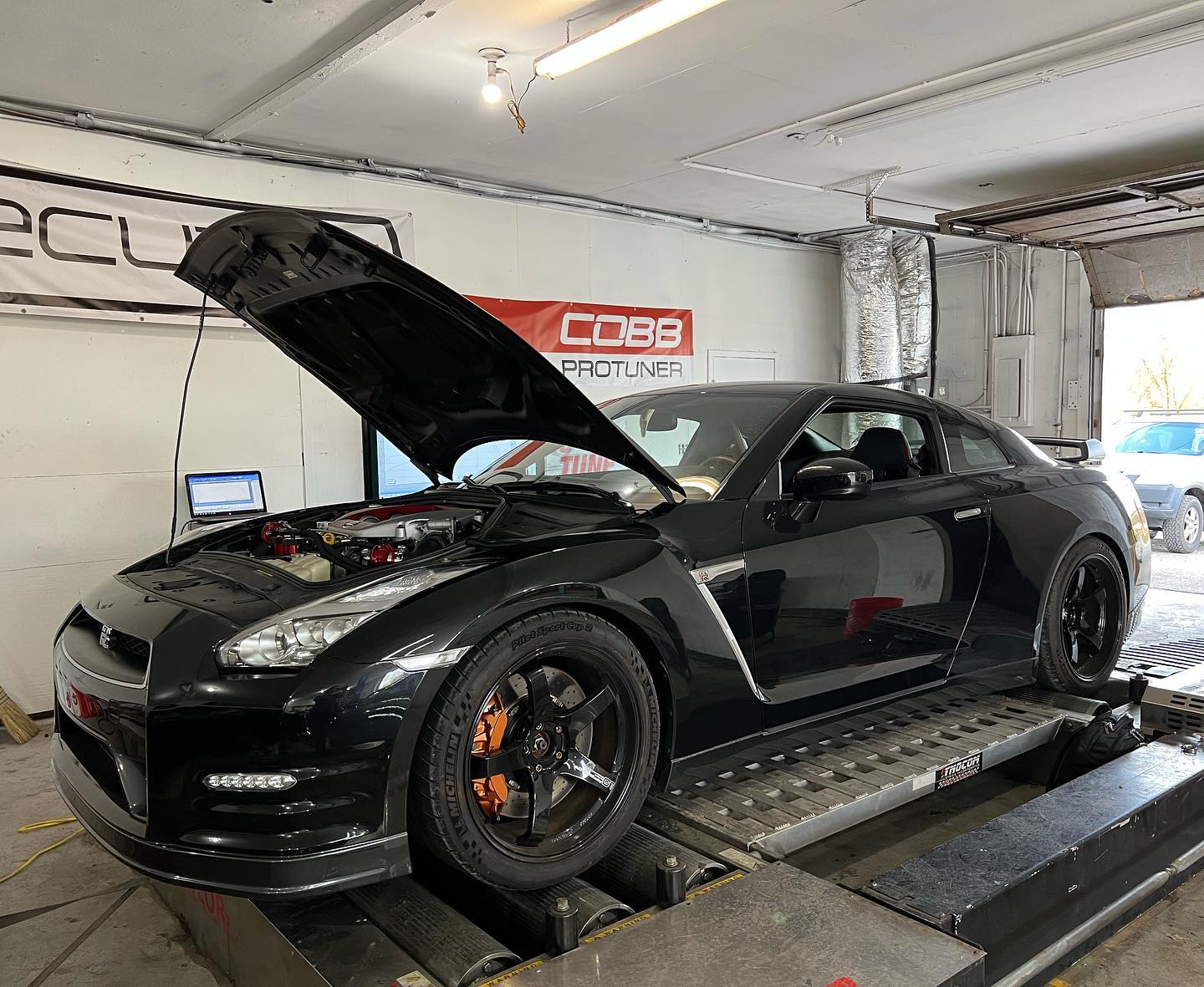
A dyno session lets the tune be checked under controlled load. Street logging is useful as well.
Book a Dyno Session to Verify Your Tune
Verifying a tune on a dyno lets it be checked at higher load under controlled conditions. A dyno lets a tuner watch knock, AFR, and timing through a clean pull without traffic, heat soak, or a ticket.
Book a dyno tuning session and you get real data instead of a hunch. We offer track-proven AWD and hub dyno tuning for Subaru, GTR, Mustang, and GM platforms, and we support HP Tuners, Cobb, ECUTEK, Motec, and Haltech.
If your car feels off after a tune, don't keep driving on hope. Bring it in, log it, and fix the root cause with Taylor'd Tuning.
A bad tune rarely fails loudly at first, but it always leaves clues in the logs. If your car is knocking, running lean, or misfiring after a flash, the fix starts with data and a proper calibration. Taylor'd Tuning brings nearly two decades of platform-specific experience, track-proven AWD and hub dyno tuning, and support for the major tuning platforms you already use. Get started with Taylor'd Tuning and drive away with a tune you can trust.
Frequently Asked Questions
Can a bad tune damage an engine?
Yes. A bad engine tune can cause engine knock, lean conditions, or excessive boost that leads to detonation, melted pistons, or bent rods. Catching the signs early, like unusual noises, misfires, or poor fuel trims, gives you a chance to stop driving and get the calibration corrected before major damage occurs. A professional dyno session or data log review can confirm whether the tune is safe.
What does engine knock sound like after tuning?
Engine knock after tuning often sounds like a metallic rattle, ticking, or pinging under acceleration, especially at low RPM or under load. It may be faint at first and grow louder as conditions worsen. If you hear this, lift off the throttle and avoid heavy load until a tuner can check the calibration and fuel quality. Persistent knock can quickly damage pistons and bearings.
Why does my car misfire after an ECU tune?
An engine misfire after tune can come from a calibration that is too aggressive for the fuel octane, worn spark plugs, or incorrect injector scaling. It may also indicate a mechanical issue that the tune exposed. Scan for misfire codes, check plug gap and heat range, and review fuel trims with a data log. A professional tuner can adjust the file or point to the hardware fix.
How can I tell if my engine is running lean?
Common engine running lean symptoms include high exhaust gas temperatures, surging, hesitation, and a check engine light for lean codes. A wideband gauge or data log showing air-fuel ratios above target under load confirms it. Lean conditions can be caused by a bad tune, a failing fuel pump, or a vacuum leak. Stop driving under boost until the cause is found to avoid engine damage.
