


Are Remote Tuning Services for GTR Worth It?
Last Updated: November 12, 2026
Quick Summary
Remote tuning works extremely well on a GT-R because the platform logs cleanly and the ECU is well understood, delivering a full custom calibration without the car leaving your garage. You flash a base file with EcuTek, log a pull, and the tuner revises the map until it is dialed in. It works poorly only when the tuner treats it as a file mill.
- Our R35 GT-R EcuTek email tuning runs $500.00 and includes the base calibration.
- Files typically go out in the order received, usually within 24 hours.
- Skipping idle and cruise logs is the most common mistake we see.
- Upgraded turbos with stock fuel is a poor fit for remote tuning; upgrade the fuel system first.
- Thirty or more days of no contact between emails may result in additional fees.
Table of Contents
- What Remote Tuning Services for GTR Actually Deliver
- How Remote Tuning Works: A Step-by-Step Walkthrough
- EcuTek Nissan GT-R Remote Tuning: Platform and Software
- Remote Tuning Services for GTR Cost: What You Pay and What's Included
- Best Remote Tuning Services for GTR: What to Look For
- Stock Turbos, Upgraded Turbos, and Fuel System Configurations
- Start Your R35 Remote Tune with Taylor'd Tuning
- Frequently Asked Questions
What Remote Tuning Services for GTR Actually Deliver
Remote tuning services for GTR owners deliver a full custom calibration without the car ever leaving your garage. A tuner sends you a base file, you flash it with EcuTek, you log a pull, and the tuner revises the map from that data.
That is the promise. The reality depends heavily on who is on the other end of the email.
At Taylor'd Tuning, we calibrate R35 GT-Rs on our AWD dyno and remotely for owners, so we know where this process shines and where it falls apart.
Below, we break down what you actually get, what it costs, and how to tell a real calibration from a generic map with your VIN on it.
Remote Tuning vs. In-Person Dyno Tuning
Remote tuning is a custom calibration built from data logs you collect on the street, while in-person dyno tuning builds the same calibration on a load-bearing dyno with the tuner physically present. Both produce a custom tune. The difference is the environment and the feedback loop.
A dyno applies controlled load in a fixed room. That lets a tuner hold an RPM cell, watch knock, fuel trims, and boost in real time, and make changes on the spot.
Here is the honest trade-off:
- Dyno tuning is faster to dial in, safer for aggressive setups, and better for validating a new turbo or fuel system before you lean on it.
- Remote tuning costs less, requires no travel, and fits owners who live far from a competent GT-R shop.
- Remote tuning depends on your logs. Garbage data in, garbage calibration out.
If your car is stock or lightly modified, remote tuning gets you a genuinely good result. If you just installed upgraded turbos and a fuel system, we would rather see the car on a dyno first.
How Remote Tuning Works: A Step-by-Step Walkthrough
The process follows a fixed loop: flash, log, review, revise. The number of revisions and the time they take depend on how modified the car is and how quickly you return logs.
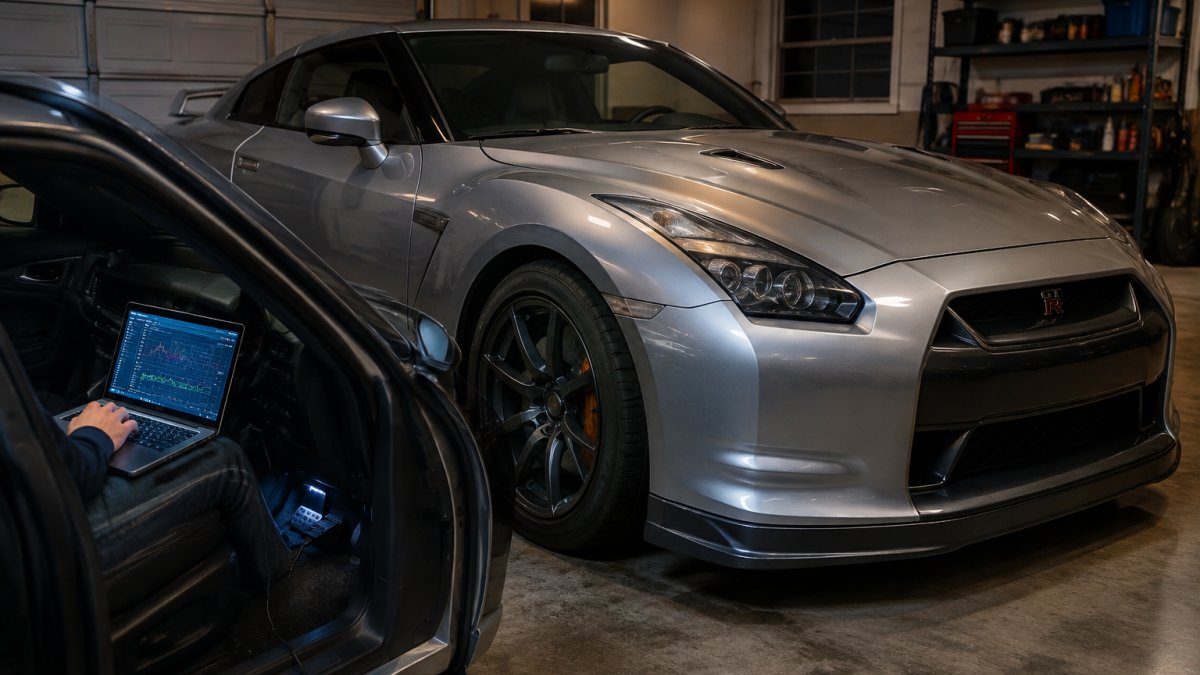
Here is the workflow we run with remote clients:
- Confirm the setup. You send a full modification list, fuel type, and any existing tune history. The tuner confirms the platform and flash points needed.
- Purchase the correct EcuTek license and flash points. If the ECU or TCM has never been tuned, you buy the appropriate flash points for both engine and transmission.
- Receive the base file. The tuner emails a startup calibration matched to your mods. Files typically go out in the order received, usually within 24 hours, though heavy workload can extend that.
- Flash the car. You load the file through EcuTek and confirm the car idles and drives normally.
- Log a pull. You capture a clean third or fourth gear pull under the tuner's instructions, plus idle and cruise data.
- Send the logs. The tuner reviews knock, fuel trims, boost targets, and transmission behavior.
- Receive revisions. The tuner adjusts the calibration and sends the next file. Repeat until the tune is clean.
- Final validation. You confirm the car holds target boost, trims stay in range, and drivability is right.
Watch out: skipping the idle and cruise logs to save time is the most common mistake we see. A file that looks clean on one wide-open-throttle pull can still have part-throttle drivability problems that only show up in daily driving data.
Prerequisites and Required Equipment
Before you buy anything, confirm you have the hardware to actually run the process. A missing cable or an unlicensed ECU stalls the tune on day one.
You will need:
- A laptop with the tuning software installed
- The correct OBD interface cable for your platform
- EcuTek flash points for the engine and transmission if the car has never been tuned
- A safe, legal stretch of road for logging pulls
- A full, accurate modification list
If you are still sorting out supporting hardware, the aFe Takeda Stage 2 intake for the R35 is a common starting point that pairs cleanly with a base calibration. Send your tuner the exact part list before the first file, not after.
EcuTek Nissan GT-R Remote Tuning: Platform and Software
EcuTek Nissan GT-R remote tuning is the standard path for the R35 because EcuTek supports both the engine ECU and the transmission control module. That matters on a GT-R, where engine and gearbox calibration have to agree.
EcuTek tuning covers the pieces a GT-R tune needs, including engine and transmission calibration. The platform also handles:
- Engine ECU calibration for fuel, ignition, boost, and torque management
- TCM calibration for shift behavior and clutch pressure
One detail owners miss: some tunes include basic transmission adjustments as part of the package, while significant TCM work is a separate add-on. Ask which one you are buying before you pay. If your car already runs a different platform, confirm the tuner supports it before committing, because not every shop works across every system.
Remote Tuning Services for GTR Cost: What You Pay and What's Included
Remote tuning services for GTR cost varies widely, and the sticker price rarely tells the whole story. What separates a fair price from an expensive one is what comes bundled: base map, revisions, support window, and transmission work.
Our R35 GT-R EcuTek email tuning runs $500.00 and includes the base calibration, with basic transmission adjustments where the setup calls for them. A few things to know before you buy:
- Flash points are separate. If your ECU or TCM has never been tuned, you buy the appropriate EcuTek flash points for both.
- Non-standard injectors may add fees. Injectors outside OEM, Injector Dynamics, or Fuel Injector Clinic may be subject to additional fees.
- Email tuning refunds are not available once the file has been emailed, as it cannot be returned.
- Files go out in the order received, typically within 24 hours, though varying workloads can extend that. Repeated messages push you further back in line.
- Long gaps may cost money. Thirty or more days of no contact between emails may result in additional fees to continue tuning.
That last point is not a penalty. It is a reflection of how tuning queues work: a stalled project still occupies a slot.
Best Remote Tuning Services for GTR: What to Look For
The best remote tuning services for GTR share four traits: GT-R-specific experience, transparent revision policy, clear hardware requirements, and a validation process that checks safety before power.
Use this checklist before you hand anyone your money:
-
[ ]
-
The listing states exactly what is included: base file, revisions, TCM work, support window
-
Flash point and license costs are disclosed up front
-
The tuner asks for a full mod list before quoting
-
Revision and refund terms are written down, not verbal
-
The tuner will tell you when a setup needs a dyno instead of a remote file
If a provider cannot answer "what is included in the price" in one sentence, that is your answer.
Red Flags and Safety Checks
A tuner who promises big power with no questions about fuel, injectors, or supporting mods is selling you a file, not a calibration. That is the single biggest red flag in this market.
Other warning signs:
- No request for data logs after the base file
- No mention of knock, fuel trims, or boost safety limits
- Refusal to explain what changed between revisions
- Packages that push boost without addressing fuel system capacity
- No written terms on revisions or refunds
On the safety side, understand one hard limit: for customers in the United States, we cannot tune to accommodate modifications that delete factory emissions equipment, and doing so may trigger a check engine light. That is not a limitation we work around. It is a line.
Stock Turbos, Upgraded Turbos, and Fuel System Configurations
Turbo and fuel setup determines what a remote tune can safely deliver. The calibration has to match the hardware, and the hardware has to support the target.
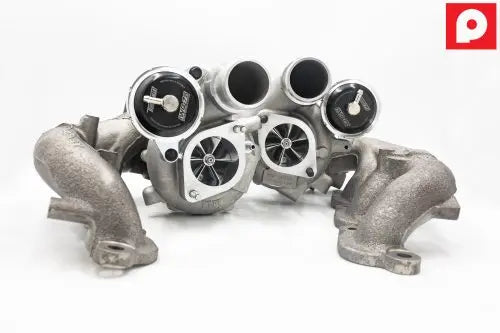
Upgraded turbos change the math. A set like the Pure1000 drop-in upgrade flows far more air and can support well beyond stock power, which means the fuel system and sensors have to keep up. A fuel rail kit and a properly sized fuel system are not optional extras at that power level; they are the foundation the tune sits on.
| Setup | Remote Tune Fit | What It Needs |
|---|---|---|
| Stock turbos, bolt-ons | Strong | Base file, logs, basic revisions |
| Stock turbos, flex fuel | Strong | Flex fuel sensor kit, ethanol content logging |
| Upgraded turbos, stock fuel | Poor | Fuel system upgrade first |
| Upgraded turbos, full fuel system | Good to strong | Dyno validation recommended |
| Single turbo, big power | Dyno first | Full supporting mods and in-person session |
We recommend intercooler and air-oil separator upgrades for all vehicles, because they are supporting modifications that matter alongside the tune. Those are supporting modifications, and they matter as much as the tune itself.
Start Your R35 Remote Tune with Taylor'd Tuning
The gap between a good remote tune and a bad one is not the file. It is the process behind it: real log review, honest revision policy, and a tuner who tells you when your setup needs more than a map.
Taylor'd Tuning has over 19 years of industry experience, with specialization in the Subaru and GT-R platforms. We run track-proven AWD and hub dyno tuning at our shop and support major platforms including HP Tuners, Cobb, EcuTek, Motec, and Haltech.
If you are ready to stop guessing, start with our R35 GT-R email tuning and send us your full mod list. We will tell you what is included, what you still need, and whether a remote file is the right call for your build.
Frequently Asked Questions
How much does a remote tune cost?
Remote tuning services for GTR cost varies by platform, fuel setup, and how many revisions your build needs. At Taylor'd Tuning, EcuTek R35 GT-R email tuning is $500.00. You may also need to buy the appropriate EcuTek flash points for the engine and transmission if your car hasn't been tuned before. TCM add-ons and non-standard injectors can add fees, so ask for a full quote before you commit.
Is remote tuning worth it for a Nissan GT-R?
It depends on your goals and how far you are from a qualified GT-R tuner. Remote tuning gives you a custom calibration without hauling the car to a shop. If you're chasing every last horsepower on a big single-turbo build, a dyno session is the better call.
How does remote tuning work for a Nissan GT-R?
You flash a base map to the ECU through EcuTek, drive the car under controlled conditions, and send data logs back to your tuner. The tuner reviews the logs, adjusts fuel, timing, and boost targets, and sends a revised file. You repeat that loop until the calibration is dialed in. Each revision depends on real driving data from your car.
What should I look for when choosing a remote GT-R tuner?
Ask what's included in the package and how the tuner handles transmission tuning. Confirm they won't tune around deleted emissions equipment, since that's a hard limit for customers in the United States. Finally, check turnaround times and refund terms before you pay, because emailed tune files are not refundable once sent.
Can a Nissan GT-R be tuned remotely with EcuTek?
Yes. You'll need the correct flash points for the engine and transmission if the car hasn't been tuned before. Taylor'd Tuning offers this as an email tuning service for $500.00, with in-person dyno tuning available at their shop.
