


The Mustang GT Custom ECU Calibration Guide
Last Updated: October 28, 2026
Quick Summary
A Mustang GT custom ECU calibration rewrites the operating instructions inside your engine control unit around your specific engine, fuel, and modifications instead of a one-size-fits-all file. It is datalogged and revised, costing more than a canned tune because it buys reliability, not just power.
- Canned tunes cannot correct for intakes, headers, injector changes, or a different fuel grade.
- Most builds settle in three to five revisions, while heavily modified cars can take more.
- Email tuning service costs $450.00, with the HP Tuners RTD4 device at $299.99 and credits at $49.99.
- An in-person dyno session is $850.00, with a minimum fee of $350 once work begins.
- Build the calibration around the fuel grade you actually run, and revisit the tune if you switch.
Table of Contents
- What a Mustang GT Custom ECU Calibration Actually Changes
- Mustang GT Custom Tune vs. Canned Tune: What the Difference Costs You
- How Mustang GT Dyno Tuning Works in Practice
- Mustang GT Remote Tuning: The Email Calibration Workflow
- What a Mustang GT ECU Tune Cost Includes
- Fuel, Modifications and Reliability Trade-Offs Before You Tune
- Book Your Mustang GT Calibration Session
- Frequently Asked Questions
What a Mustang GT Custom ECU Calibration Actually Changes
A Mustang GT custom ECU calibration is a rewrite of the operating instructions inside your car's engine control unit, built around your specific engine, fuel, and modifications rather than a one-size-fits-all file.
Engine and ECU Identification by Generation
- 2011-2014 GT: 5.0L Coyote V8 with port injection and an early-generation PCM. Owners often need upgraded injectors before adding airflow mods.
- 2015-2017 GT: Revised Coyote with a different PCM strategy. Injector upgrades depend on how far you push the build.
- 2018-2023 GT: Dual-injection Coyote (port and direct injection) with a more complex ECU that rewards careful fuel mapping.
- 2024+ S650 GT: The newest generation, now supported for tuning through the HP Tuners platform.
Mustang GT Custom Tune vs. Canned Tune: What the Difference Costs You
A canned tune is a pre-built file sold for a broad range of cars. A custom tune is written for your vehicle, datalogged, and revised. That distinction is the whole ballgame.
Canned tunes are cheaper and faster, and for a completely stock car they can deliver a modest performance boost. Where they fall short is anything outside the factory envelope: cold air intakes, headers, injector changes, or a different fuel grade. A canned file can't see your datalog, so it can't correct for what your engine is actually doing.
A Mustang GT custom tune costs more because someone reads your calibration data, adjusts air-fuel ratio and ignition timing, and validates the result. What most guides miss is that the extra money buys reliability, not just power. A properly calibrated Coyote runs smoother and holds up better under sustained load.
How Mustang GT Dyno Tuning Works in Practice
Taylor'd Tuning offers track-proven AWD and hub dyno tuning.
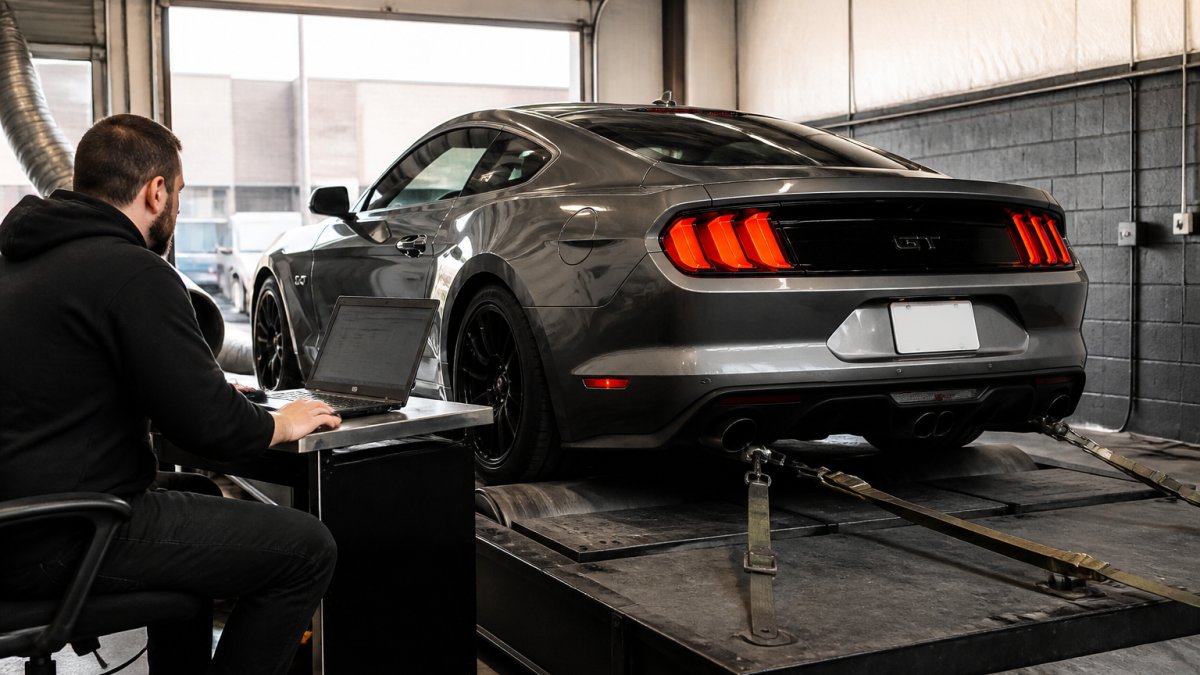
Our dyno tuning and calibration sessions outline the options.
Dyno Testing Versus Street Tuning
Dyno testing gives you repeatable, controlled conditions and a safe place to push the engine. Street tuning gives you real airflow, real heat soak, and real throttle transitions. Neither replaces the other.
The best calibrations use both. We dial in the fundamentals on the dyno, then validate drivability on the street so the part-throttle behavior and smooth throttle response feel right in daily driving. A car that makes a great dyno number but drives poorly is a failed tune.
Mustang GT Remote Tuning: The Email Calibration Workflow
Taylor'd Tuning offers remote tuning for Ford Mustang vehicles by email. See our Ford Mustang email tuning with HP Tuners RTD page for information about the remote tuning process.

Step 1: Hardware and Licensing
The Ford Mustang email tuning listing states that the HP Tuners RTD device and ECU unlock credits are purchased separately. Check with Taylor'd Tuning about support for your setup before purchasing.
Step 2: Stock File Read and Build Sheet
You read your stock file and send it in along with a build sheet: model year, transmission, fuel grade you actually run, and every airflow or fueling modification. This is where most remote tunes go wrong, a file built for the wrong injector size or fuel grade starts the whole loop in the wrong place. Be honest about the fuel in the tank, not the fuel you plan to buy.
Step 3: Base Calibration
We send a base calibration built for your modifications. Treat this as a starting point, not a finished file. The base file establishes safe fuel and timing margins; the revisions that follow are where the calibration becomes yours.
Step 4: Datalogging and the Revision Loop
You datalog, send the log, and we revise. A useful log is a specific drive, not a random commute:
- A steady cruise segment at part throttle to check fuel trims.
- Two or three wide-open-throttle pulls in a safe location, in third or fourth gear, from low RPM to redline.
- A heat-soak segment, idle or low-speed running after the pulls, to see how the calibration behaves when intake temperatures climb.
Each log is reviewed against the parameters in the next section. A revision typically adjusts one or two tables at a time so the effect of each change is measurable. Most builds settle in three to five revisions; a heavily modified car or a fuel change can take more. If a log shows knock retard or a lean condition under load, the next file pulls timing or adds fuel before anything else is touched.
FORD Mustang Email tuning with HP Tuners RTD →
Step 5: Validation and Sign-Off
Our Ford Mustang email tuning with HP Tuners RTD page provides information about the remote tuning process, and the RTD4 remote tuning device is available separately.

What a Mustang GT ECU Tune Cost Includes
| Item | What It Covers | Price |
|---|---|---|
| Email tuning service | Custom calibration and revisions | $450.00 |
| HP Tuners RTD4 device | Datalogging and flashing hardware | $299.99 |
| Universal credits | ECU licensing | $49.99 |
| In-person dyno session | Live calibration on the dyno | $850.00 |
The Ford Mustang email tuning price does not include the HP Tuners RTD device or ECU unlock credits; those are purchased separately. Our HP Tuners universal credits page explains that the number of credits required varies by vehicle. Dyno sessions have a minimum fee of $350 once work begins.

Fuel, Modifications and Reliability Trade-Offs Before You Tune
Fuel grade is the first decision, not an afterthought. Higher-octane fuel resists knock, which lets a calibrator run more ignition timing safely. Tuning for premium and then filling with regular is a recipe for pulled timing and lost power. The calibration should be built around the fuel you will actually run, and if you switch grades, the tune needs to be revisited.
Calibration by Setup
The same Coyote needs different calibration attention depending on how far it is from stock:
- Stock or near-stock: the calibration mainly sharpens throttle response, cleans up part-throttle drivability, and safely uses the fuel grade you run. Gains are modest and reliability risk is low.
- Intake and exhaust only: airflow changes shift fueling and load calculations. The calibration must reflect the new airflow so fuel trims stay in range instead of the ECU constantly correcting.
- Headers and injector changes: injector size and exhaust scavenging change fueling enough that a canned file is unsafe. Injector data must be entered correctly or the engine runs rich or lean at the wrong times.
- Forced induction: boost adds load and heat, so knock control, air-fuel ratio under boost, and temperature limits become the primary safety margins. This is where a custom calibration is not optional.
What the Calibrator Watches
The Ford Mustang email tuning listing recommends air-oil separator upgrades for all vehicles and states that an AEM X Series wideband may be required for some applications without factory widebands.
One more thing worth saying plainly: we cannot tune to accommodate removal of factory emissions equipment on any vehicle. That's a hard line, and it protects you.
Book Your Mustang GT Calibration Session
You've got the workflow, the costs, and the trade-offs. The last step is getting a real calibration on your car instead of another generic file.
Taylor'd Tuning has over 19 years of industry experience, offers track-proven AWD and hub dyno tuning, and supports HP Tuners, Cobb, ECUTEK, Motec, and Haltech platforms. To book a dyno appointment, see our dyno appointment deposit listing.
Frequently Asked Questions
How much does a custom ECU tune for a Mustang GT cost?
At Taylor'd Tuning, Ford Mustang email tuning with HP Tuners RTD is $450. The price does not include the RTD device or ECU unlock credits, which must be purchased separately. Dyno tuning and calibration sessions are listed at $850; prices do not include software licenses, credits, or flashpoints. Check the product listings for details about your setup.
Can you tune a Mustang GT using the stock ECU?
The Ford Mustang email tuning listing offers tuning for Mustang applications using HP Tuners RTD. Contact Taylor'd Tuning to ask whether your specific setup is supported.
Is dyno tuning or remote tuning better for a Mustang GT?
Taylor'd Tuning offers dyno tuning and remote email tuning for Ford Mustangs. The right service depends on your setup; contact Taylor'd Tuning to discuss your options.
What modifications should be installed before tuning a Mustang GT?
The Ford Mustang email tuning listing recommends air-oil separator upgrades for all vehicles and PMAS or JLT cold air intakes. It states that 2011-2014 vehicles need Ford Racing LU47 injectors, while 2015-2017 vehicles may need them depending on other modifications. An AEM X Series wideband may be required for some applications without factory widebands. For U.S.-based customers, Taylor'd Tuning cannot tune to accommodate modifications to factory emissions equipment.
Can an ECU tune affect a Mustang GT's reliability or warranty?
For U.S.-based customers, Taylor'd Tuning cannot tune to accommodate modifications to factory emissions equipment. The dyno tuning listing notes that modifying factory emissions equipment may result in a check engine light.
How long does a custom Mustang GT tune take?
Email tuning files are typically sent within 1-7 days during business hours, though workload can extend that time. The listing states that 30 or more days without contact between emails may result in additional fees to continue tuning.
Your Mustang GT deserves a calibration built around its actual engine, fuel, and modifications, not a file that was never written for your car. Get started with Taylor'd Tuning and drive away with a calibration that delivers real power gains, crisp throttle response, and reliability you can trust under load.
