


7 Remote Tuning Safety Checks for Your GT-R
Last Updated: November 17, 2026
Quick Summary
Remote tuning is safe for a GT-R when three conditions line up: a healthy car, a tuner who actually reads your logs, and a process with real revision cycles. The file often gets blamed, but the setup is usually the culprit, so verify fuel pressure, compression, and codes before you buy.
- A remote tune is a custom calibration delivered by email, flashed through a handheld device, then refined over several data-logged revisions.
- Tuning with injectors other than OEM, Injector Dynamics, or fuel injector clinic injectors may be subject to additional fees.
- Full-throttle pulls belong on a closed course or a private road, never a public highway.
- Files go out in the order received, typically within 24 hours, and refunds aren't available once a file has been emailed.
- A brand-new build with a turbo kit, injectors, and a fuel system all changed at once needs dyno time.
Table of Contents
- Why Remote Tuning Safety Hinges on the Setup, Not the File
- GT-R Remote Tuning Requirements: Hardware, Software, and Logs
- Remote Tuning vs. Dyno Tuning: What Each One Actually Verifies
- GT-R Remote Tuning Safety Checks Before, During, and After
- Nissan GT-R E-Tune Risks Specific to the R35 Platform
- How to Verify a Tuner Before You Send a Single Log
- When Remote Tuning Is Not the Right Call
- Frequently Asked Questions
Why Remote Tuning Safety Hinges on the Setup, Not the File
Is remote tuning safe for GTR owners?
A remote tune is a custom calibration delivered by email, flashed through a handheld device, then refined over several data-logged revisions. Nothing about the delivery method makes it risky.
Below, we'll show you how the process works on the R35, what to check before you buy, and when to book dyno time instead.
GT-R Remote Tuning Requirements: Hardware, Software, and Logs
Before any calibration discussion, you need to know what the R35 requires. GT-R remote tuning requirements break into three buckets: ECU and TCM access, a data-logging device, and honest information about your build.
ECU, TCM, and Licensing Basics
The R35 runs separate engine and transmission computers. vehicles that have never been tuned need the appropriate flash points purchased for the engine and transmission.
A calibration is the set of tables and limits the engine management system uses to decide fuel, boost, and ignition timing. On a stock-transmission car, basic transmission adjustments may be included in the base service. Significant TCM work is a separate add-on.
What Your Tuner Needs From You
Your tuner cannot see your car. Everything they know comes from what you send. A complete intake looks like this:
- Full modification list, including fuel system parts and injector brand
- Fuel octane you actually run, not what you plan to run
- Current diagnostic codes, active or stored
- Vehicle logs from third-gear full-throttle pulls
- Elevation and typical ambient temperatures
- Any known hardware faults, even minor ones
Tuning with injectors other than OEM, Injector Dynamics, or fuel injector clinic injectors may be subject to additional fees. 7 steps to build a custom base map walks through how that starting file gets assembled.
Remote Tuning vs. Dyno Tuning: What Each One Actually Verifies
Remote tuning verifies your car on the road under real load and real airflow. Dyno tuning verifies it in a controlled cell. Neither is universally better.
| Factor | Remote Tuning | Dyno Tuning |
|---|---|---|
| Environment | Real road, real airflow | Controlled cell |
| Load consistency | Varies by road and weather | Repeatable |
| Knock detection | Relies on factory sensors and logs | Monitored live |
| Turnaround | Days, across revisions | Same day, usually |
| Best for | Bolt-on cars, mild setups | Big turbo, new fuel system |
| Cost structure | Lower, per file | Higher, per session |
A dyno pull is not a road pull. Heat soak, airflow, and load differ.
GT-R Remote Tuning Safety Checks Before, During, and After
GT-R remote tuning safety checks are the part most buyers skip, and it's where the real risk lives. Work through this checklist in order.
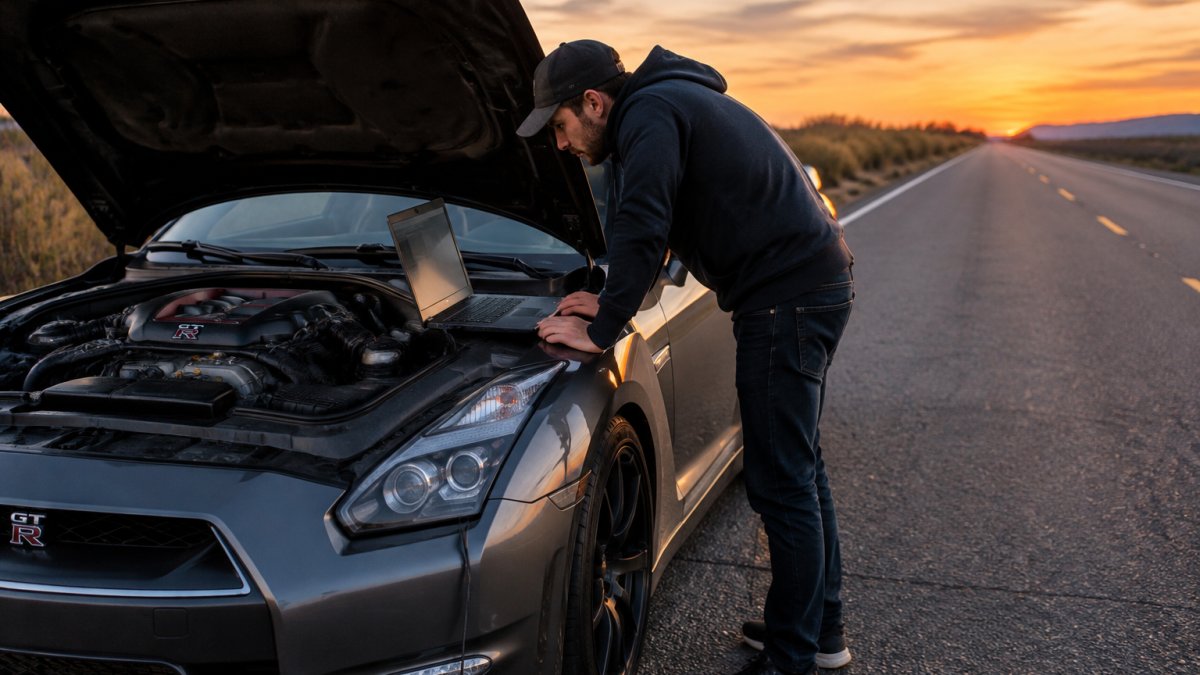
Before you buy:
- Compression and leak-down test completed, with results on hand
- Fuel pressure verified under load, not just at idle
- Plugs gapped to the spec your tuner recommends and in good condition
- No unresolved diagnostic codes, active or stored
- Intercooler and air-oil separator upgraded or planned
- Tuner confirmed platform experience with the R35
- A safe place to collect third-gear full-throttle logs identified in advance
- Handheld device registered and the appropriate ECU and TCM flash points purchased
During tuning:
- Log every revision, not just the final one
- Send complete pulls, not partial clips
- Report any new noise, smell, or behavior immediately
- Never add parts mid-process without telling your tuner
- Stop the pull the moment a warning sign appears (see below)
After the final revision:
- Re-check codes after a week of driving
- Confirm boost targets match what was agreed
- Keep the log files archived for future reference
- Re-log a pull in similar weather to confirm the calibration holds
We recommend intercooler and air-oil separator upgrades for all vehicles.
Reading Logs and Spotting Warning Signs
A log is only useful if you know what a bad one looks like.
- Knock retard that doesn't clear. A brief pull of timing on a hot day is normal. Knock retard that persists after the pull, or grows revision after revision, means stop and send the log before the next pull.
- Air-fuel ratio drifting lean under boost. A ratio that climbs leaner than your tuner's target, especially at higher rpm, points to a fuel system running out of headroom. Do not repeat the pull to "confirm."
- Fuel trims pinned positive at wide-open throttle. Long-term trims adding fuel at WOT usually mean the pump, injectors, or calibration are not keeping up. This is a hardware conversation, not a file tweak.
- Boost that spikes then falls off sharply. A spike followed by a collapse can indicate a boost control issue, a restriction, or a calibration asking for more than the hardware can hold.
- Intake air temperatures climbing pull after pull. Heat soak changes the calibration's behavior. If IATs keep rising, let the car cool before logging again so the data reflects the tune, not the heat.
- Any new noise, smell, or vibration. Mechanical symptoms outrank log numbers. Stop and investigate before the next revision.
A common mistake is chasing peak boost while ignoring ignition timing. More boost with pulled timing makes less power and more heat. Signs of a bad engine tune covers the diagnostic side in more depth if you suspect something is already off.
A single clean log may not be enough; logging across more than one session gives a fuller picture.
Where to Log Safely and Legally
Full-throttle pulls belong on a closed course or a private road, never a public highway. Beyond the danger, street pulls produce inconsistent data because traffic forces you to lift mid-pull, and a partial pull tells your tuner less than a complete one.
Plan the session before you go: pick a location where you can run a full third-gear pull and safely slow down, note the weather and ambient temperature with the log, and confirm the handheld is recording every channel your tuner asked for. Performance tuning for track days explains how to plan logging sessions where conditions are controlled and data is clean.
Watch out: local rules on speed and road use vary, and a pull that feels isolated can still be a citation or a hazard.
Nissan GT-R E-Tune Risks Specific to the R35 Platform
A Nissan GT-R e-tune has to account for a dual-clutch transmission and the limits of the stock fuel system once boost rises.
Three risks stand out. First, transmission torque limits: pushing engine torque past what the TCM calibration expects wears clutches fast. Second, fuel system capacity: the stock setup has limits, and a tuner working remotely depends entirely on your logs to see them. Third, emissions-related modifications: we cannot tune to accommodate any modification that deletes factory emissions equipment, and you may see a check engine light if you modify that way.
None of these are reasons to avoid remote tuning. They're reasons to be honest about your build and to pick a tuner who asks hard questions before sending a file.
How to Verify a Tuner Before You Send a Single Log
Verification takes fifteen minutes and saves engines. The goal is to separate a tuner who actually reads R35 logs from one who forwards a file and moves on.
Platform experience:
- How many R35s have you calibrated, and what is your typical build range (bolt-on, upgraded turbos, fuel system changes)?
- Which ECUTEK features do you use on the engine and transmission side, and do you handle TCM calibration in-house or as an add-on?
- Can you describe a recent R35 log you reviewed and what you changed as a result?
Logging and revision process:
- Which channels do you want logged, and do you review every revision or only the final one?
- How many revisions does a typical e-tune include, and what happens if the car still isn't right after the last one?
- What is your turnaround per revision, and how do you handle a log that looks bad?
Support and terms:
- What is your communication policy during the process, and how quickly do you respond to a log review request?
- What are your refund terms once a file has been emailed?
- What do you do when a build needs dyno time instead of remote revisions?
Then check the terms. Reputable remote tuning involves clear refund terms, realistic turnaround windows, and a stated communication policy.
Are remote tuning services for GTR worth it? breaks down the value question if you're still weighing the decision.
When Remote Tuning Is Not the Right Call
Remote tuning is the wrong choice in four situations. A brand-new build with a turbo kit, injectors, and a fuel system all changed at once needs dyno time, because there are too many variables to sort out through logs alone. A car with an unresolved mechanical fault needs a diagnosis first, not a calibration. A vehicle chasing a maximum-effort number on a stock engine needs a conversation about reliability, not a file. And a car with no logging device or no willingness to pull logs has no path forward at all.
For everyone else, a conservative tune built across several revisions is both safe and effective. That's the honest answer to whether remote tuning is safe for a GTR: it's as safe as the process around it.
If you've read this far, you're probably ready to stop guessing and get a calibration built around your actual setup. Get started with Taylor'd Tuning and start your R35 e-tune.
Frequently Asked Questions
Is remote tuning safe for a Nissan GT-R?
It can be, provided the car is mechanically healthy and the tuner works from real data logs rather than a generic map. A remote tuning file is only as good as the logs behind it, so the process depends on clean full-throttle pulls, reviewed revisions, and a tuner who checks knock, fuel trims, and boost against your actual setup. Cars with existing hardware faults, fuel system limits, or worn dual-clutch transmission clutches should be diagnosed before any file is flashed.
What are the GT-R remote tuning requirements before I start?
You need a supported tuning platform with the correct flash points for both engine and transmission, a laptop or handheld that can log, and a car with no active diagnostic codes. Taylor'd Tuning's R35 email tuning runs $500.00, and vehicles that have never been tuned need the appropriate ECUTEK flash points. Expect to send logs, receive a revision, and repeat until the calibration is dialed in. Intercooler and air-oil separator upgrades are recommended on all cars.
Is a remote tune as reliable as a dyno tune?
The comparison between remote tuning and dyno tuning comes down to what gets measured. A dyno holds load in a controlled cell. Remote tuning relies on logs from real conditions and typically takes more rounds.
How can I tell whether a remote GT-R tuner is trustworthy?
Ask for platform-specific experience, not general claims. A trustworthy tuner will explain how they review logs, what knock and fuel trim thresholds they watch, how many revisions are included, and what they do when a log looks bad. Confirm they support your exact ECU and TCM combination, ask about refund terms up front, and be wary of anyone promising a fixed power number before seeing a single log from your car.
