


How to Book a Professional Dyno Tuning Session
Last Updated: October 25, 2026
Quick Summary
To book a professional dyno tuning session, confirm your ECU platform and full modification list, contact the shop with your goals, then pay the non-refundable $150.00 deposit to hold your appointment. Your appointment is not booked until the deposit is paid, and dyno tuning sessions start at $850.00.
- Every dyno or tuning session carries a $350 minimum fee once work begins, regardless of outcome.
- Each $150.00 deposit allows one reschedule before a second deposit is required.
- Quoted prices exclude software ECU licenses, credits, and flashpoints, so budget for those on top.
- A mild bolt-on car on a stock ECU usually fits in a half-day block; standalone builds should book a full day.
- Cars with active fault codes, mechanical problems, or emissions deletions get turned away before the dyno.
Table of Contents
- What to Expect From a Professional Dyno Tuning Session
- Your Dyno Tuning Preparation Checklist
- How to Choose the Right Dyno Session for Your Build
- Dyno Tune Cost: Base Rates, Deposits, and Additional Charges
- Dyno Tuning Session Length: How Long Should You Plan For?
- Remote Tuning vs Dyno Tuning: What Actually Changes
- Safety, Eligibility, and Why a Vehicle Gets Turned Away
- Book Your Dyno Tuning Session With Taylor'd Tuning
- Frequently Asked Questions
What to Expect From a Professional Dyno Tuning Session
Booking a professional dyno tuning session is the most direct way to turn a pile of aftermarket parts into a car that actually behaves.
The difference between this and a mail-order file is the feedback loop. On the dyno, every change gets measured in the same hour it was made.
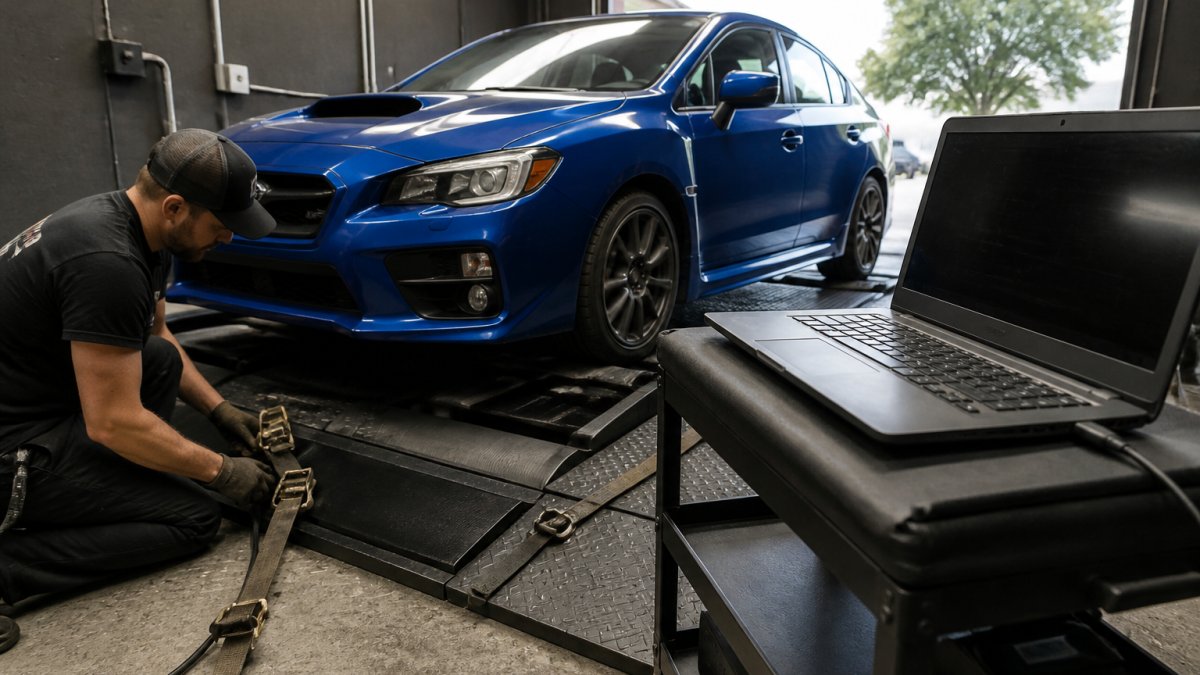
The Dyno Pull Process and Live Tuning
Each dyno pull is a controlled acceleration run under load. The tuner watches air-fuel ratio, knock, and boost in real time, then adjusts fuel mapping and ignition timing between pulls. Live tuning means the calibration changes while the car is running, so a session typically involves several pulls rather than one. Expect the tuner to stop early if a pull shows something unsafe.
ECU Scanning and Diagnostics Before the Pulls
No reputable shop tunes a car it has not scanned first. An ECU scan and vehicle diagnostics pass catches stored fault codes, sensor drift, and fuel trim problems that would otherwise get baked into your custom tune. A common mistake is showing up with an unresolved check engine light and expecting the tuner to "tune around it." We won't, and most performance shops won't either.
Your Dyno Tuning Preparation Checklist
A dyno tuning preparation checklist is what separates a smooth session from a wasted appointment. The single biggest reason a car underperforms on the dyno is something the owner could have caught a week earlier. Run through this before you load the car:
- Fresh oil and filter, and no fluid leaks
- Correct spark plugs, gapped and in good condition
- Full tank of the fuel you actually plan to run
That last item matters more than people think. Injector changes often carry additional fees because the calibration baseline shifts, so tell the shop up front rather than at the bay door.
How to Choose the Right Dyno Session for Your Build
Match the session to the build, not to the price list. A lightly modified daily driver needs a straightforward stock ECU calibration. A heavily modified race car with a standalone ECU and custom sensor strategies needs an advanced setup block with more labor built in.
Ask three questions before you book: What ECU platform am I on? What exactly has been changed? Am I chasing a street setup, a track setup, or both? The answers determine session type, duration, and whether you should be looking at in-house dyno time, an off-site dyno of your choice, or track-side support.
AWD Dyno vs Hub Dyno: Which One Fits Your Car
An AWD dyno loads all four wheels through the tires, which mirrors how the car behaves on the road. A hub dyno bolts directly to the hubs, removing tire slip and wheel weight from the measurement. For a Subaru WRX or STI, the AWD dyno is the natural fit because it reproduces real drivetrain load. Hub dyno tuning suits cars where you want tighter control over wheelspin and repeatability, particularly high-power builds. Neither is "better." They answer different questions, and a shop that runs both can tell you which one your combination needs.
Dyno Tune Cost: Base Rates, Deposits, and Additional Charges
Dyno tune cost breaks into three parts: the base rate, the deposit, and any additional charges. Our dyno tuning and calibration sessions start at $850.00, and every dyno or tuning session carries a minimum fee of $350 once work begins, regardless of outcome. That minimum exists because diagnosis and setup time happen whether or not the car makes a clean pull.
The deposit is separate and non-refundable. Your appointment is not booked until the deposit is paid, so secure your non-refundable dyno appointment deposit when you are ready to lock in a date.

Watch out: quoted prices do not include software ECU licenses, credits, or flashpoints, and injector changes outside stock may add fees. Budget for those on top of the base rate.
Here is how the money breaks down before you book.
| Item | Value | Note |
|---|---|---|
| Base dyno tuning and calibration rate | Starts at $850.00 | Starting price for a session |
| Minimum fee once work begins | $350 | Applies regardless of outcome |
| Dyno appointment deposit | $150.00 | Non-refundable, comes off total price |
| Reschedules allowed per deposit | One | Second reschedule requires another deposit |
| ECU licenses, credits, flashpoints | Not included | Budget on top of base rate |
| Injector changes outside stock | May add fees | Tell the shop up front |
Dyno Tuning Session Length: How Long Should You Plan For?
Plan for a partial day, not an hour. Dyno tuning session length depends on how far the calibration has to move, and the clock covers diagnosis and setup as much as wide-open-throttle runs. A realistic way to budget your day is to think in blocks rather than minutes:
Dyno Tuning and Calibration sessions →
- Intake and safety check (30-60 minutes): strapping the car down, setting tire pressures, verifying fuel level and octane, pulling the ECU scan, and confirming the modification list matches what is actually on the car.
- Baseline pulls (20-40 minutes): two to four instrumented pulls to establish where the car starts. This is data you cannot skip, without a baseline you have no way to prove the tune helped.
- Calibration cycles (the bulk of the day): each cycle is a pull, a review of the log, and a map adjustment. A stock ECU car with bolt-ons typically needs fewer cycles than a standalone setup with custom sensor strategies, flex fuel, or boost-by-gear tables.
Two things stretch a session: unresolved mechanical issues and incomplete modification lists. A car that arrives with a pending code, a boost leak, or an injector change the shop did not know about can burn an hour before the first clean pull. Two things shrink it: a healthy car and a tuner who already knows the platform. If you are driving in from out of town, tell the shop your constraints when you book so the schedule reflects reality rather than optimism.
A practical rule of thumb most tuners will confirm: a mild bolt-on car on a stock ECU usually fits in a half-day block, while a standalone build with a new turbo, injectors, and flex fuel should be booked as a full day. If you are unsure, book the longer block, finishing early is a good problem, and running out of time mid-calibration means paying for a second appointment.
Remote Tuning vs Dyno Tuning: What Actually Changes
Remote tuning vs dyno tuning comes down to where the measurement happens and what you can prove afterward. Remote tuning sends you calibrated files based on data logs you collect on the street; dyno tuning measures the car under controlled load in a single session with a tuner watching live.
Here is the honest trade-off. Remote tuning gives you flexibility and no travel. Dyno tuning gives you recorded results, a dyno graph, and a tuner who can hear and feel a problem instead of inferring it from a log.
How to Read the Dyno Graph You Leave With
The dyno graph is the deliverable that separates a dyno session from a street log, and most owners never learn to read one. A few things to look at:
- Peak horsepower and peak torque are not the whole story. Look at where the curves make power, not just the peak number. A tune that adds 15 hp at redline but loses 20 lb-ft at 3,500 rpm may feel slower on the street than the graph suggests.
- The shape of the torque curve matters more than the peak. A broad, flat torque curve is what makes a car feel strong in daily driving; a peaky curve that only wakes up above 5,000 rpm is a track-oriented result.
- Air-fuel ratio (AFR) should be stable through the pull. A tuner targets a specific AFR under load, rich enough to control combustion temperature, lean enough to make power. Wavy or drifting AFR on the graph is a sign the calibration is still being worked out.
If your goal is a documented result you can show a buyer, a tuner, or a race sanctioning body, the dyno graph is the artifact that matters. If your goal is a mild revision to an existing tune and you already have a logging device, remote tuning can get you there for less travel and less shop time. Neither path is wrong, they answer different questions, and the right choice depends on what you need to prove when the session is over.
Safety, Eligibility, and Why a Vehicle Gets Turned Away
A car gets turned away when tuning it would be unsafe or when the shop cannot legally calibrate it. Common reasons include active fault codes, mechanical problems like low compression or a failing fuel pump, unsafe tires, fluid leaks, and incomplete installations.
There is also a hard line on emissions. We cannot tune to accommodate modifications that delete factory emissions equipment on any vehicle, and you may see a check engine light if the car is modified that way.
Book Your Dyno Tuning Session With Taylor'd Tuning
Booking is a short sequence, and skipping a step costs you a slot. Here is how we would do it:
- Confirm your ECU platform and full modification list
- Email or call with your goals and any track dates
- Pay the deposit to hold the appointment
- Complete the intake form with your vehicle details
- Run the preparation checklist the week before
- Arrive with the fuel you plan to run and your tuning device
We tune Subaru, GTR, Mustang, and GM platforms across HP Tuners, Cobb, ECUTEK, Motec, and Haltech, with both AWD and hub dyno options in house plus off-site and track-side support. If you are not sure which session fits, ask before you buy; guessing is how people end up paying for the wrong block of time. Book your dyno tuning and calibration session and we will confirm the right setup for your build.

Frequently Asked Questions
How much does a professional dyno tune cost?
At Taylor'd Tuning, dyno tuning and calibration sessions start at $850. A $150 non-refundable deposit is required to book, and that amount comes off your total. Prices do not include software ECU licenses, credits, or flashpoints. Tuning with certain aftermarket injectors may add fees. Every dyno or tuning session carries a $350 minimum fee once work begins, regardless of outcome. Contact the shop before purchasing if you are unsure which option fits your build.
How long does a dyno tuning session take?
Plan for a half day to a full day for a standard dyno tuning session, depending on your modifications and how many pulls are needed. Advanced standalone setups and extensive racing builds take longer because more time goes into sensor configuration and custom strategies. Taylor'd Tuning schedules sessions in blocks so there is enough dyno time to dial in fuel mapping and ignition timing without rushing. Ask about the estimated hours when you book.
What should I do before a dyno tuning appointment?
Run through a dyno tuning preparation checklist: confirm fresh oil and proper fluid levels, check for boost leaks and vacuum leaks, make sure the ECU is healthy with no unresolved fault codes, and verify your tuning device is unlocked and ready. Bring any build details, previous tune files, and a list of installed modifications. Arrive with the fuel level you plan to tune on. If your car has emissions equipment removed, note that Taylor'd Tuning cannot tune for that.
Is dyno tuning better than remote tuning?
Dyno tuning lets the tuner measure power output, torque, and air-fuel ratio under controlled load on a chassis dyno or hub dyno, then make live tuning changes in real time. Remote tuning works from data logs you collect on the street or track and is convenient if you are not near a performance shop. For heavily modified cars or first-time custom tune work, a dyno session gives more precise results. Taylor'd Tuning offers both, so you can pick based on your build and location.
The gap between a car that runs and a car that runs right is usually calibration, not parts. Taylor'd Tuning brings 17+ years of experience tuning and modifying cars and trucks, track-proven AWD and hub dyno tuning, and support for HP Tuners, Cobb, ECUTEK, Motec, and Haltech platforms. Get started with Taylor'd Tuning and turn your modification list into a measured, reliable setup.
