


The Safe Way to Tune a Subaru WRX STI
Last Updated: November 21, 2026
Quick Summary
To tune a Subaru WRX STI safely, verify the engine is healthy with a compression and leak-down test, boost leak check, and fresh plugs before any flash, then choose a calibration that matches your modifications. Monitor the result with data logging so knock, air-fuel ratio, and boost error stay in range.
- A pre-tune inspection includes a compression and leak-down test, boost leak test, and fresh correctly gapped plugs.
- Install supporting hardware first, then calibrate once, rather than flashing repeatedly as parts trickle in.
- A downpipe without a tune is an uncontrolled boost increase, not a bolt-on.
- A dyno tune lets the calibrator watch knock, boost, and air-fuel ratio in real time under controlled load.
- Keep a baseline log from the day the tune was finalized so you have something to compare against.
Table of Contents
- Why Tuning a Subaru WRX STI Is a Safety Decision First
- The Pre-Tune Inspection: Your WRX STI Tuning Checklist
- WRX STI Mods That Require a Tune (and What to Install First)
- WRX STI Dyno Tune vs E-Tune: Which Is Safer for Your Engine
- Fuel Quality, Octane, and Ethanol: The Limits You Cannot Tune Around
- How to Monitor a Tune and Catch Danger Signs Early
- What WRX STI Tuning Cost Really Looks Like
- Book a Safe Calibration With Taylor'd Tuning
- Frequently Asked Questions
Why Tuning a Subaru WRX STI Is a Safety Decision First
To tune a Subaru WRX STI safely, treat every calibration change as an engine reliability decision, not just a horsepower decision. At Taylor'd Tuning, we calibrate Subaru and GTR platforms, and the owners who get years of hard use from a tuned car are the ones who plan the whole combination before the first flash.
Here is the tension nobody puts on a product page. A stock tune is conservative because Subaru has to warranty the car in every climate, on every tank of fuel, for every driver. An aftermarket tune removes that safety margin in exchange for power.
We group safe tuning into three phases: verify the engine is healthy, choose the calibration path that matches your modifications, and monitor the result with data logging.
The Pre-Tune Inspection: Your WRX STI Tuning Checklist
A pre-tune inspection is a mechanical health check performed before you tune a Subaru. A compression and leak-down test, a boost leak check, fresh plugs gapped correctly, and a look at fuel trims tell you whether the engine can accept more cylinder pressure at all.
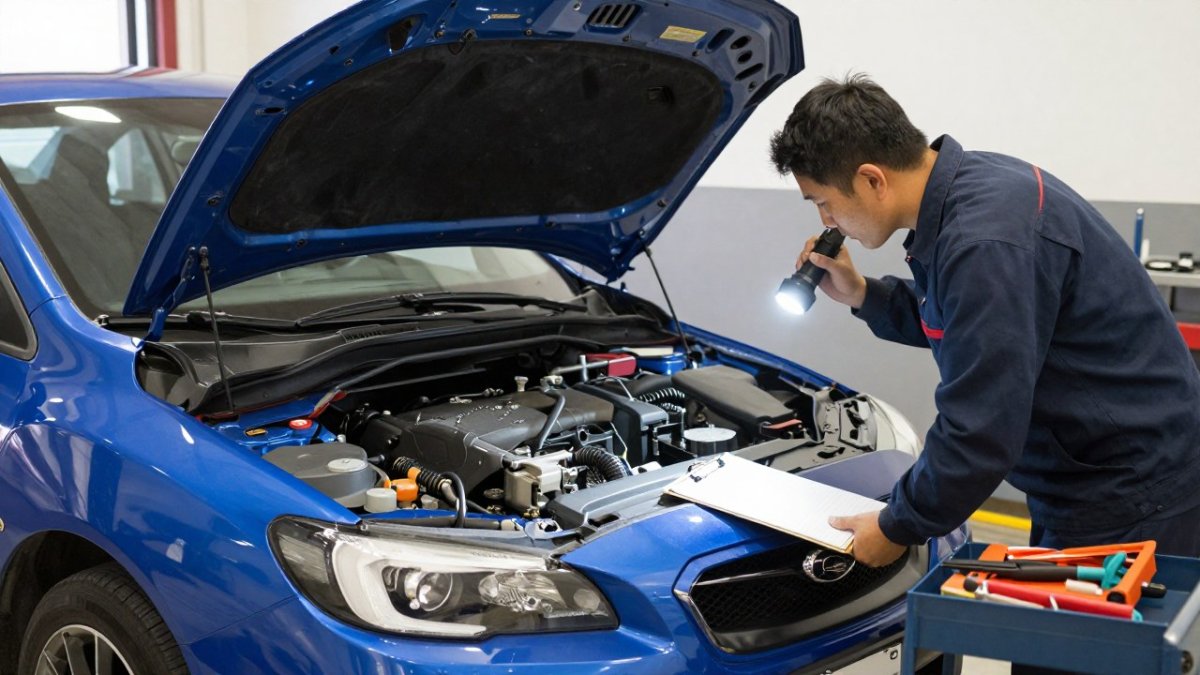
Run through this before you book anything:
- Compression and leak-down test on all cylinders
- Boost leak test on the intake tract and intercooler couplers
- Fresh spark plugs, gapped to spec for your target boost
- Oil and filter change, plus a look for fuel smell in the oil
- Check for excessive blow-by; a catch tank addresses it before you add boost
- Verify fuel pressure and inspect the in-tank filter
- Scan for stored codes and review fuel trims at idle and cruise
- Confirm the clutch and transmission are up to the planned torque
Watch out: a car that pulls timing or shows lean trims at cruise may already have a problem. If you want to deal with blow-by before adding boost, an oil catch tank for the VA chassis is a sensible pre-tune addition.
WRX STI Mods That Require a Tune (and What to Install First)
Any modification that changes airflow, fuel delivery, or exhaust restriction requires a tune, because the factory calibration no longer matches what the engine is actually doing. That includes intakes, downpipes, injectors, fuel pumps, ethanol content, and boost control changes. The order matters more than the parts list: install supporting hardware first, then calibrate once, rather than flashing repeatedly as parts trickle in.
What most guides skip is that the safe sequence depends on which engine you have. Use the roadmap below as a starting point, then confirm against your specific model year and current health check.
EJ25 (2004-2014 STI, and 2002-2014 WRX with the EJ255):
FA20DIT (2015+ WRX):
EJ257 (2015+ STI):
A staged plan with reliability trade-offs looks like this:
- Stage 0 (supporting, low risk): Catch can or air-oil separator, fresh plugs gapped to spec, boost leak test, oil change. No tune required, but these protect the engine before you add load.
- Stage 1 (tune required): Intake and/or charge pipe, custom tune. Modest power gain, low drivetrain stress.
- Stage 2 (tune required): Downpipe or turbo-back exhaust, custom tune. More boost and spool change; clutch wear accelerates on manual cars.
- Stage 3 (tune and fueling required): Injectors, fuel pump, ethanol or larger turbo. Highest power, highest stress on rods, ringlands, and the stock clutch.
Watch out: a downpipe without a tune is not a bolt-on, it is an uncontrolled boost increase. If you are planning the full combination at once, a Subaru Stage E tune parts package bundles the intake, Accessport, and calibration so the hardware matches the tune. Older STI owners converting side-feed to top-feed fueling can start with a fuel rail conversion kit with 1000cc injectors rather than piecing it together.
WRX STI Dyno Tune vs E-Tune: Which Is Safer for Your Engine
A dyno tune allows the calibrator to watch knock, boost, and air-fuel ratio in real time under controlled load. An e-tune is written for your specific modifications, using data logs you send back and forth.
| Method | How It Works | Best For | Main Risk |
|---|---|---|---|
| Off-the-shelf map | Pre-built map flashed from an Accessport | Stock or lightly modified cars | Generic calibration, no verification |
| E-tune | You log, tuner revises, repeat | Bolt-on cars, remote owners | Relies on your logging quality |
| Dyno tune | Calibrator tunes live on a load-bearing dyno | Big turbo, ethanol, built engines | Higher cost, travel required |
An off-the-shelf tune is a pre-loaded calibration that assumes a specific parts combination. A custom tune is written for your exact setup. The gap between them is where engines fail.
Fuel Quality, Octane, and Ethanol: The Limits You Cannot Tune Around
Fuel quality sets the ceiling on safe boost, and no calibration can fix bad gas. Octane rating measures resistance to knock; run lower octane than the tune expects and the ECU pulls timing or, worse, detonates before it can react.
Ethanol changes the rules. E85 carries a much higher effective octane and cooling effect, which supports more aggressive timing and boost, but it also demands more fuel volume and consistent content. A blend that varies tank to tank forces the calibration to guess.
That is why flex fuel hardware matters. A flex fuel sensor kit lets the ECU read ethanol content and adjust, rather than assuming a fixed blend. Owners pushing ethanol on a WRX STI also need fuel volume to match, which is where a dual-pump fuel module earns its place.
A common mistake is tuning on a full tank of good fuel and then filling up somewhere unknown. If your calibration assumes a specific octane, treat every fill as part of the safety system.
How to Monitor a Tune and Catch Danger Signs Early
Monitoring a tune means logging the right channels regularly and knowing which numbers indicate trouble. Feedback knock correction, fine knock learning, air-fuel ratio under load, boost error, and fuel trims are the five channels that matter most. What most guides leave out is what to do with the numbers once you have them.
- Feedback knock correction and fine knock learning: Small, occasional corrections (a degree or two) on a hot day or a bad tank are normal. A pattern of corrections on the same cylinder, or corrections that grow pull after pull, means the calibration and the fuel no longer agree. Stop the pull and investigate.
- Air-fuel ratio under load: A tune built for pump gas typically targets the low-to-mid 11s at full boost. If the actual ratio leans out at high RPM compared with earlier logs, you may have a failing fuel pump, a clogged filter, or a boost leak. Do not continue wide-open-throttle pulls until it is resolved.
- Boost error (target vs. actual): Overshoot beyond the target the tune was built for can mean a stuck wastegate, a bad boost control solenoid, or a calibration that no longer matches the hardware. Undershoot can mean a boost leak.
- Fuel trims (short-term and long-term): Trims drifting more than a few percent from where they sat when the tune was finalized suggest an intake leak, a dirty mass-air sensor, or a fuel delivery change. A large positive long-term trim at cruise is a classic unmetered-air sign.
- Oil temperature and oil pressure under sustained load: Rising oil temperature or falling oil pressure during repeated pulls is a mechanical warning, not a tuning one. Back off and check oil level and condition.
If you see repeated knock correction on the same cylinder, air-fuel ratio leaning out at high RPM, or boost overshoot on consecutive pulls, stop driving under load and re-log at part throttle before you book a revision.
The NHTSA guidance on vehicle safety defects is a reminder that warning signs exist to be acted on, not cleared. Keep a baseline log from the day the tune was finalized so you have something to compare against. Without a baseline, a "normal" reading is just a guess.
What WRX STI Tuning Cost Really Looks Like
WRX STI tuning cost breaks into hardware, calibration, and supporting parts, and the calibration line is usually the smallest. Owners underestimate the supporting parts, which is where reliability is actually bought.
Here is how our pricing breaks down:
- Cobb Accessport: $770
- Subaru e-tune: $325
- Dyno tuning session: $850
- Stage 1 parts and tune package: $1,395
- Tuning consultation and one-on-one instruction: $350
Watch out: none of those figures include ECU licenses, flash points, or software credits. Budget for them before you commit. Our dyno tuning sessions page lists what each option includes.
WRX STI Tuning Costs at Taylor'd Tuning
Book a Safe Calibration With Taylor'd Tuning
A tuned car's longevity depends on the whole setup: a healthy engine, the right parts, fuel quality, and monitoring the data.
Taylor'd Tuning offers track-proven all-wheel-drive and hub dyno tuning and supports Cobb, ECUTEK, HP Tuners, Motec, and Haltech platforms. Whether you are local to our shop near Nashville or tuning remotely from another state, we work from your setup.
Get started with Taylor'd Tuning and put your WRX STI on a calibration built for how you actually drive it.
Frequently Asked Questions
How much horsepower can a Subaru WRX STI safely handle?
It depends on the engine platform and its condition. Taylor'd Tuning lists Stage 1 gains at roughly +35-55 whp on 2008-21 EJ25 vehicles and +45-60 whp on 2015-21 FA20 vehicles. Beyond that, the question shifts from tuning to hardware: rods, pistons, fueling and cooling all become limiting factors. A compression and leak-down test before you tune tells you what your specific engine can take.
Which WRX STI mods that require a tune should I install first?
Start with parts that support the tune rather than stress it. An intercooler and an air-oil separator are recommended on all vehicles, and an AEM X Series wideband is required for proper calibration on EJ20 and EJ25 applications. A cold air intake, charge pipe and panel filter are the typical Stage 1 hardware. Anything that changes airflow, fueling or boost needs a calibration to match, so install the parts as a set and tune once instead of flashing between mismatched setups.
Is a dyno tune or e-tune safer for a WRX STI?
A dyno tune lets the tuner watch boost, air-fuel ratio and knock in real time under controlled load. An e-tune relies on you capturing clean data logs on the street. Taylor'd Tuning offers both, at $850 for dyno sessions and $325 for Subaru email tuning.
How much does it cost to tune a Subaru WRX STI?
At Taylor'd Tuning, a Subaru email tune is $325 and an in-person dyno tuning session is $850, with software licenses, credits and flash points priced separately. A Cobb AccessPort runs $770 if you do not already own one, and the Stage 1 parts and tuning package bundles intake, AccessPort and email protune at $1,395.
What should I check before tuning a WRX STI?
Check compression and leak-down on all cylinders, pressure-test the intake for boost leaks, and verify the fuel system can support the target. Replace old spark plugs, change oil and filter, and scan for stored codes. Fix any existing fault before the first flash.
Is a tuned Subaru WRX STI less reliable than a stock one?
A conservative tune on a healthy engine with quality fuel is not automatically a reliability problem. Risk climbs when boost is pushed past what the hardware supports, when fuel quality drops, or when maintenance is skipped. Keep boost and timing within what your parts can handle, and address small issues before they grow. Reliability is a function of the whole setup, not the tune file alone.
