


Custom Dyno Tuning for Subaru WRX: 2026 Guide
Table of Contents
- Custom Dyno Tuning for Subaru WRX: What It Is and Why It Matters
- WRX Dyno Tune vs E-Tune: Which One Fits Your Build?
- Subaru WRX Dyno Tune Cost: A Transparent Breakdown
- WRX Tuning for Aftermarket Parts: Making Mods Work Together
- Subaru WRX Dyno Tuning Checklist: Prep Before the Session
- What Happens During a Dyno Session: Pulls, Data, and Revisions
- Safety Limits, Reliability, and Legal Considerations
- Frequently Asked Questions
Last Updated: October 21, 2026
Custom Dyno Tuning for Subaru WRX: What It Is and Why It Matters
Custom dyno tuning for Subaru WRX is the process of calibrating the factory ECU on a load-bearing dyno while a tuner monitors live data, adjusting fuel, boost, and ignition timing to match your exact modifications.

The gap matters more than most owners expect. An off-the-shelf map assumes a stock or near-stock car. Your WRX isn't that car.
ECU calibration is the adjustment of the engine control unit's fuel, timing, and boost tables to hit a target air-fuel ratio and power output safely. A dyno tune performs that calibration under controlled load instead of guessing from street logs.
WRX Dyno Tune vs E-Tune: Which One Fits Your Build?
The short answer: a dyno tune wins for heavily modified cars, and an e-tune wins on convenience for mild setups.

| Factor | Dyno Tune | E-Tune |
|---|---|---|
| Where it happens | In-shop, controlled load | Street logs, remote revisions |
| Best for | Big turbo, flex fuel, built engines | Stage 1, bolt-ons, stock turbo |
| Feedback loop | Immediate, same session | Days between revisions |
| Cost | $850 session | $325 tune |
| Risk with aggressive mods | Lower, monitored live | Higher, logs only |
An e-tune isn't a lesser product, it's a different tool. For a stock-turbo car with an intake and exhaust, remote revisions get you most of the way there. Push boost and fuel beyond what the factory turbo and injectors were sized for, and you want the car strapped down.
Subaru WRX Dyno Tune Cost: A Transparent Breakdown
A custom dyno tune is not one line item. It is a session fee, a device or license, supporting hardware, and sometimes diagnostic or repair work that surfaces on the dyno. The number owners quote to each other is usually just the session fee, which is why budgets surprise people.
Our dyno tuning and calibration sessions run $850, and a $150 non-refundable deposit books the appointment and comes off the total. Software licenses, credits, and flashpoints are not included in that number. Every dyno and remote session also carries a $350 minimum once work begins, regardless of outcome.

Here is how the costs actually stack up by scenario:
- Stock-turbo car, already owns a Cobb Accessport: session fee plus any license or flashpoint your platform requires. This is the simplest path and the one most stage 1 and stage 2 owners fall into.
- Stock-turbo car, no device: add a Cobb Accessport at $770, or confirm whether your tuner supports an open-source or factory-ECU path that avoids buying hardware you will not use.
- Flex fuel or injector upgrade: add injectors, pump, and flex fuel hardware. Our Subaru flex fuel parts and tuning package at $1,895 bundles injectors, pump, pressure kit, flex fuel kit, and tuning for 2008-21 EJ25 cars.
- Big turbo or built engine: add turbo, fueling, and supporting parts, plus additional dyno time. These builds rarely finish in a single short session.
- Car arrives with problems: add diagnosis and repair. A boost leak, failing sensor, or unresolved check-engine code eats session time and may require a reschedule.
A few cost mechanics are worth understanding before you compare quotes:
- Session time is priced, not promised horsepower. A tuner who quotes a flat fee for a big-turbo build is either very confident or planning to stop early. Ask how many pulls and how many hours are included.
- Licensing is platform-specific. Cobb, ECUTEK, HP Tuners, Motec, and Haltech each handle licensing differently, and some charge per vehicle or per flashpoint. Confirm what is included before you pay a deposit.
- Deposits are usually non-refundable. Ours is, and that is common. Reschedule once is typical; no-shows usually forfeit.
- Hardware you already own changes the math. If you have an Accessport, say so up front. If you do not, ask whether the tuner can work with the platform you prefer rather than forcing a switch.
Ask for a written estimate that separates session fee, device or license, hardware, and contingency. A shop that will not itemize is a shop you cannot compare against anyone else.
WRX Tuning for Aftermarket Parts: Making Mods Work Together
Aftermarket parts don't add power in isolation, they change how the engine breathes, fuels, and manages heat, and the calibration has to account for all of it at once. A downpipe without a tune runs lean.
We group mods into three tiers, and each one changes what the tune has to do:
- Breathing mods (intake, exhaust, intercooler): recalibrate airflow and charge temps
- Fueling mods (injectors, pump, flex fuel): rescale fuel tables and add safety margin
- Pressure mods (turbo upgrade, wastegate, boost control): rebuild boost targets around the new hardware
What most guides miss: the intercooler and air-oil separator upgrades we recommend for every car aren't power mods. They're reliability mods, and they make the tune safer to push.
Subaru WRX Dyno Tuning Checklist: Prep Before the Session
A Subaru WRX dyno tuning checklist saves you money because a car that isn't ready burns dyno time on diagnosis instead of calibration. Show up with fresh plugs gapped correctly, clean oil, a full tank of the fuel you'll actually run, and no active check-engine codes. Bring your mod list in writing. Confirming your fuel system is prepared for the specific demands of tuning for ethanol ensures that your engine remains safe and responsive under the increased load of a custom calibration.
- Fresh spark plugs, correct gap for your boost target
- Oil and filter changed within the last 1,000 miles
- Full tank of the octane you plan to run
- No stored or pending check-engine codes
- Wideband installed where required (AEM X Series on EJ20/EJ25)
- Written mod list, including injector brand and size
- Boost leak test completed
- Tuning device paired and firmware updated
The single most common delay we see is a car arriving with unresolved codes or a boost leak. Both eat session time and both are free to fix beforehand.
What Happens During a Dyno Session: Pulls, Data, and Revisions
A dyno session runs in a repeatable loop: baseline pull, data review, calibration revision, another pull.
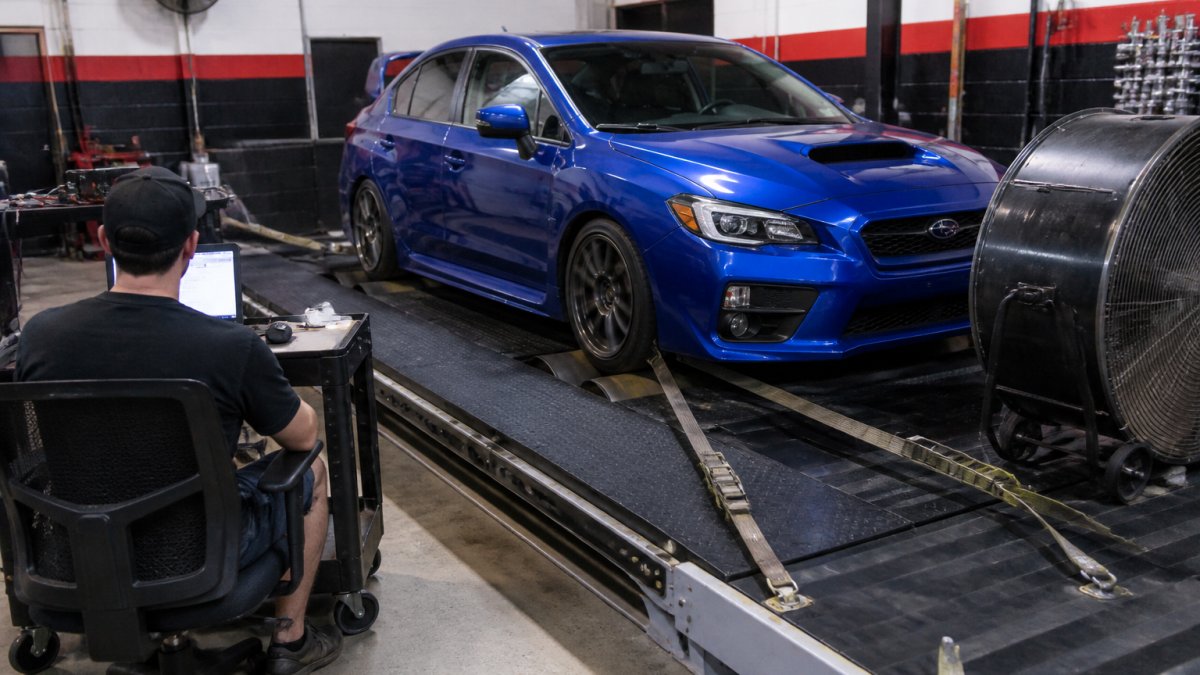
Each dyno pull is a controlled acceleration run under load while the tuner logs air-fuel ratio, boost pressure, knock, fueling, and ignition timing. If knock shows up, timing comes out.
Expect multiple pulls per session. A clean stage 1 car may need a handful. A flex fuel or big-turbo build can take considerably more, which is why we quote sessions rather than promising a one-hour turnaround.
Safety Limits, Reliability, and Legal Considerations
Power is the easy part. The hard part is deciding how much margin to leave on the table, and that decision belongs to you and your tuner together. A calibration that makes a big number on a cool morning can be the same calibration that knocks on a hot afternoon with a tired fuel pump.
Four variables set the real ceiling on a WRX calibration:
- Knock. The ECU pulls timing when it detects knock, and a tuner watches knock sum and feedback knock during every pull. If knock shows up, timing comes out. Chasing timing back in on a hot day or on lower-octane fuel is how ringlands fail. Run the octane the tune was written for, every tank.
- Boost. More boost means more cylinder pressure and more heat. A stock turbo on a stock engine has a practical ceiling, and a tuner who will not exceed it is protecting your engine, not leaving power on the table. Big-turbo builds raise the ceiling only when fueling and intercooling keep up.
- Fueling. Air-fuel ratio is the safety net. Lean under load raises combustion temperature and knock risk. Injector duty cycle, fuel pressure, and pump condition all matter. A tired pump that flows fine at idle can fall short at redline, which is why fuel pressure is logged on every pull.
- Engine condition. Compression, leakdown, oil consumption, and boost leaks all affect how much a calibration can safely ask for. A car with a small boost leak or low compression will not make the same safe power as a healthy one, and no tune fixes mechanical problems.
A common pattern is to target a fuel and timing safety margin rather than a peak number, then validate on the dyno and on the street.
On the legal side, emissions compliance is not negotiable for us. As noted in EPA emissions compliance guidance, tampering with factory emissions equipment is federally prohibited, and we cannot tune around any modification that deletes it. For broader context on how aftermarket calibration interacts with federal clean air rules, the EPA's vehicle and engine compliance resources are worth reading before you buy parts.
A tune that deletes or defeats emissions equipment isn't something we'll write.
Ask your tuner what safety margin the calibration targets and what conditions would make them pull timing or boost. A tuner who can explain the trade-offs is a tuner who will protect your engine.
Frequently Asked Questions
How much does a Subaru WRX dyno tune cost?
At Taylor'd Tuning, dyno tuning and calibration sessions start at $850, and a $150 non-refundable deposit books your appointment and comes off the total. Software licenses, ECU credits, and flash points are separate, and injectors other than OEM, Injector Dynamics, or Fuel Injector Clinic may add fees. All sessions carry a $350 minimum once tuning begins. Email tuning@taylordtuning.com with your year, model, and mods for an exact quote.
Is a dyno tune better than an e-tune for a WRX?
A dyno tune lets the calibrator watch air-fuel ratio, boost pressure, and knock in real time on a loaded AWD dyno, so changes happen in one session with immediate verification. An e-tune relies on data logs you collect on the street, with files typically returned in 1-7 business days. The WRX dyno tune vs e-tune choice comes down to build complexity and timeline: mild setups do well on an e-tune, while heavily modified cars benefit from in-person dyno time.
What should I do to prepare my Subaru WRX for a dyno tune?
Start with a Subaru WRX dyno tuning checklist: fresh oil and filter, spark plugs gapped for your boost target, a boost leak test, and a full tank of the fuel you plan to run. Fix any check engine lights and confirm your tuning device is married and up to date. For EJ20 and EJ25 applications, an AEM X Series wideband is required for safe calibration. Bring your complete mod list and performance goals to the session.
Can I dyno tune a WRX with aftermarket modifications?
Yes. WRX tuning for aftermarket parts is where custom calibration pays off, because the tune has to account for how an intake, exhaust, or flex fuel kit changes airflow and fueling. Taylor'd Tuning supports Cobb Accessport, ECUTEK, HP Tuners, Motec, and Haltech platforms. One limit: the shop cannot tune for modifications that delete factory emissions equipment, and those changes may trigger a check engine light.
How long does a Subaru WRX dyno tune take?
Most sessions run several hours, and complex builds may need multiple sessions or revisions. The time covers a baseline pull, calibration changes, and verification pulls on the dyno. Email tuning files are sent in the order received, typically within 1-7 business days Monday through Friday, 10am-5pm CST, though workload can extend that window. Book through Sales@taylordtuning.com or 6153595203 to confirm scheduling.
Does a custom tune affect reliability or warranty coverage?
A calibration built around your actual modifications, fuel quality, and power goals is safer than a generic map pushed to the limit. Taylor'd Tuning tests its flex fuel packages on stock engines with good results and longevity, but recommends engine upgrades for vehicles that want to reliably increase performance. On warranty, aftermarket calibration can affect coverage, so check with your dealer before tuning. Tuning and modifications are for off-road racing use only.
If your WRX has outgrown its off-the-shelf map, the next step is a calibration built around your actual parts list. Taylor'd Tuning offers track-proven AWD dyno tuning and remote e-tunes for Subaru, GTR, Mustang, and GM platforms, with support for Cobb, ECUTEK, HP Tuners, Motec, and Haltech. Book a session or send your mod list to tuning@taylordtuning.com and we'll tell you what your build actually needs. Get started with Taylor'd Tuning and stop guessing what your engine is doing under load.